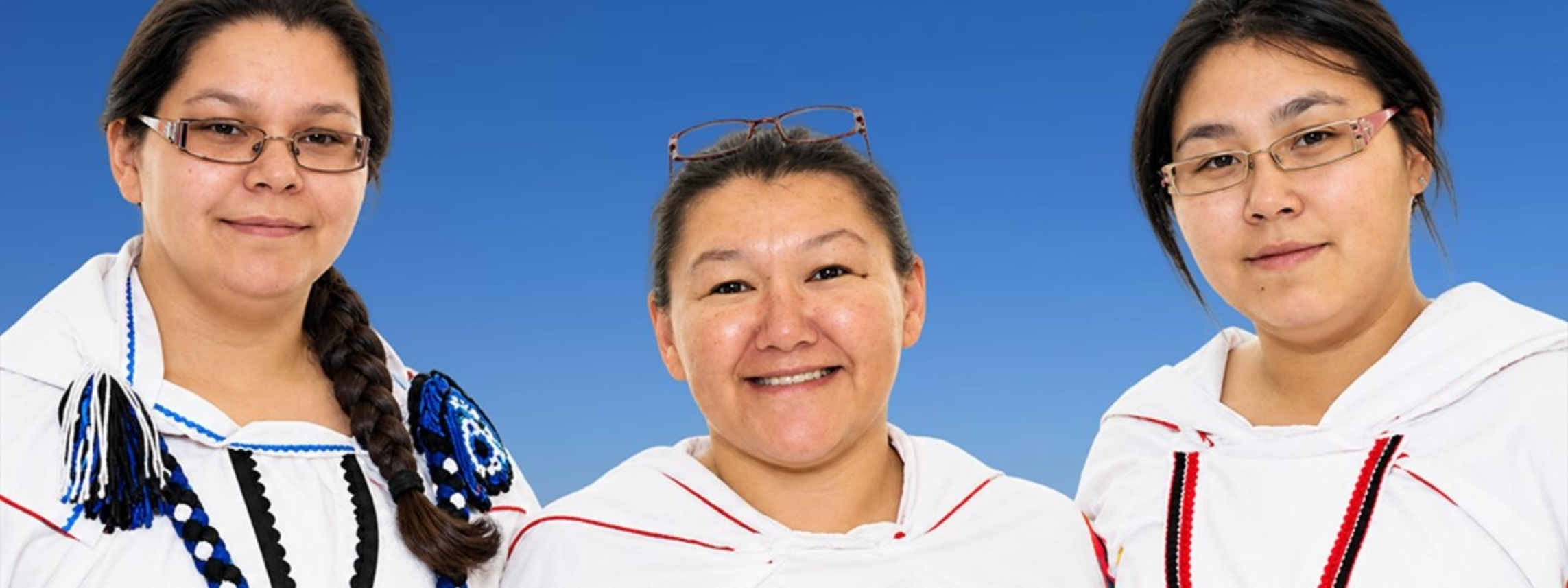
In Salluit, a remote Inuit community on the Hudson Strait, midwife Samantha Leclerc provides care through pregnancy, birth and the postpartum period. The nearest hospital offering specialized care is a plane ride away, and there is no local capacity for caesarean sections. Midwives working here need extensive emergency skills and must carefully assess when someone can safely give birth in the community and when additional care is needed.
For families, having midwives in Salluit means they have the possibility of welcoming their babies close to home.
Today, 86% of births among the Hudson coast population take place in Nunavik—a dramatic shift from the era when 91% of women were evacuated outside the region to give birth.
“We’re privileged to have this program so that our women can stay in the community to give birth.”
The Inuulitsivik midwifery service has spent nearly four decades making that possible. Today, it is nationally and internationally recognized as a model for remote maternity care and the reclamation of Indigenous midwifery. Its history also shows how much was lost when birth was removed from Inuit communities, and what communities have regained by bringing it home.
Bringing birth back to Nunavik
Inuit midwives cared for pregnant people and families for generations. This changed dramatically in the second half of the twentieth century, when pregnant Inuit women were increasingly sent away from their communities to give birth in southern hospitals.
Before the Inuulitsivik midwifery service was established in 1986, 91% of women on Nunavik’s Hudson coast were evacuated to hospitals outside the region for birth.
The consequences went well beyond the distance travelled. Community consultations found that evacuation was associated with loss of autonomy, family stress and medicalized birth. Researchers have described how the practice recreated some of the trauma and social dislocation Inuit communities had already experienced through residential schools and other colonial policies.
The birth centres that eventually replaced routine evacuation came out of activism by Inuit women, health workers and community leaders. Inuulitsivik opened its first midwifery-led birth centre in Puvirnituq in 1986, followed by Inukjuak in 1998 and Salluit in 2004.
CBC’s 2023 Hands of a Midwife, by Padraig Moran and Duncan McCue, traces this history through the experiences of Inuit midwives and the women who pushed to bring birth back to their communities.
The story has also attracted international attention. In 2020, The New York Times published Giving Birth Where the Family Is, written by Amber Bracken and Megan Specia, about Inuit-led maternity care in Nunavik and the return of birth to communities.
More recently, the Inuulitsivik midwifery team has documented the history and development of the program themselves. Their 2025 paper, What makes Inuulitsivik midwifery successful and sustainable?, draws on nearly 40 years of experience to examine what has allowed the service to endure.
A model built for Nunavik
Providing maternity care in communities without surgical or specialist services requires an approach designed for the realities of remote care.
Inuulitsivik midwives work as part of an interdisciplinary health team that includes nurses and family physicians, with specialists consulted when needed. Montreal, the major tertiary referral centre, is more than 1,500 kilometres from the Hudson coast.
This makes emergency preparation a central part of the job.
“We have emergency training because when you’re up north, you’re alone.”
Midwives provide care throughout pregnancy, working to identify and prevent complications where possible and collaborating with other health professionals when more specialized care is needed.
Research on the program shows that this approach has allowed the great majority of families to remain in Nunavik for birth.
A 2012 study examined 1,372 labours and 1,382 babies cared for by the Inuulitsivik service between 2000 and 2007. During that period, 86.3% of births occurred in Nunavik. Midwives attended 84% of births for which the attendant was known, with Inuit midwives attending 72.8%.
Of births for which mode of delivery was known, 97.1% were spontaneous vaginal births. Caesarean sections accounted for 2.1% and occurred after transfer under physician care.
The researchers found low rates of intervention with safe outcomes and concluded that the results supported the potential for safe, culturally competent maternity care in remote communities without local caesarean-section capacity.
These results are particularly significant because Inuulitsivik does not serve only a narrowly defined “low-risk” population. Midwives care for the population as a whole, including people with medical and socioeconomic risk factors.
Despite resourcing issues, local birth remains the norm. In their 2025 paper, members of the Inuulitsivik midwifery team report that 86% of births among the Hudson coast population take place in Nunavik. Looking at outcomes from 2000 to 2015, they report that 92% of Puvirnituq residents gave birth in Puvirnituq. Among Inukjuak residents, 70% gave birth in their own community and 79% somewhere in Nunavik. In Salluit, 69% gave birth in Salluit and 82% gave birth within Nunavik.
The service is now approaching 5,000 births attended by Inuulitsivik midwives.
Training midwives at home
One of the distinctive features of Inuulitsivik is that Inuit women can train as midwives in Nunavik.
Samantha began as a postpartum worker, supporting midwives after births, before becoming a student midwife herself.
Students are employees of the health centre and learn while working alongside experienced midwives. The program is competency-based and incorporates observation, role modelling, storytelling, case review and oral teaching. Although southern midwives initially played a significant role in education, local Inuit midwives have increasingly become the teachers responsible for preparing the next generation.
“Because we’re in Salluit, it takes four to five years for us to graduate, because we go by number of births. We had about 28 births in Salluit last year, which is a good number for our population, but it still takes a while.”
The Inuulitsivik team identifies local education as one of the foundations of the program’s long-term sustainability. Students are paid members of the health-care team, an important consideration when many are parents who need to support their families. Students and local midwives also provide continuity in a health system where health professionals from the south may remain in the region for relatively short periods.
Over time, Inuit graduates have become the main teachers and mentors of new students. The program allows clinical knowledge to remain in the communities where it is needed and gives experienced Inuit midwives a central role in preparing those who come after them.
A broad role in community health
The work of Inuulitsivik midwives extends well beyond labour and birth.
Their scope includes prenatal and postpartum care, well-baby care, sexual and reproductive health and emergency care. In some emergencies, midwives may be the lead caregivers for mothers and newborns until transport can be arranged.
The Inuulitsivik team describes this broad scope as an important adaptation to working in small, remote communities. Midwives provide services that might otherwise fall to family physicians or public health nurses, including contraception, sexually transmitted and blood-borne infection prevention, cancer screening and community health education.
Midwives also lead local perinatal care. The program uses an interdisciplinary Perinatal Committee where midwives, students, nurses and physicians review cases later in pregnancy and develop individual care plans, including plans for where each person will give birth.
This combination of local expertise and access to a wider medical team is one of the features the Inuulitsivik midwives themselves identify as central to the program’s success.
What it means to give birth at home
Clinical outcomes tell only part of the story.
For someone who has to leave Salluit to give birth, evacuation can mean leaving children and other family members behind and spending weeks away from home. Elders and extended family who would otherwise be part of the birth may not be able to travel.
“It’s important for our women to give birth in their own community, with their family around them.”
The Inuulitsivik team describes care in Inuktitut, family support during labour and birth, and the transmission of Inuit knowledge about pregnancy, birth and parenting as fundamental parts of its approach. The service is part of a wider movement to maintain and apply Inuit cultural knowledge in health care.
Local care can also make room for Inuit practices that may not be well understood within southern institutions. Samantha gives the example of customary adoption, in which a baby may be adopted within the extended family or community. This helps protect families from traumas associated with Canada’s legal and child welfare systems
The 2012 Inuulitsivik study found that 23% of babies in its dataset were recorded as adopted, which the researchers note is consistent with the Inuit cultural tradition of adoption within family and community.
There is also an intimacy to receiving care from someone who is already part of your community.
“When you’re from the community, you know your people. You know their stories, their fears, their strength.”
For Samantha, that relationship continues long after a baby is born. She sees children she helped welcome into the world grow up around her, and, eventually, become parents themselves.
Nearly 40 years of bringing birth home
Inuulitsivik began because Inuit communities wanted women to be able to give birth closer to home. Nearly 40 years later, the program has grown from one maternity in Puvirnituq to services in three communities, while Inuit midwives educated in Nunavik have become the core of the service and the teachers of new midwives.
The 2025 paper identifies several factors that have made that longevity possible: Inuit values and language, Inuit leadership, local education, an expanded role for midwives, flexibility, midwifery-led interdisciplinary care and collaboration with outside partners. The authors describe the service as part of a broader effort to reclaim Indigenous capacity and governance in health care.
For families in communities like Salluit, the impact is also much more immediate.
A baby can be born close to siblings, grandparents and extended family. Care can be provided by people who know the community. Inuit women can become midwives without leaving Nunavik to pursue their education elsewhere. Those midwives can go on to teach the next generation.
Almost four decades after Inuit women and community leaders fought to bring birth back to the Hudson coast, that work continues in the hands of midwives like Samantha.
References
Bracken, A., & Specia, M. (2020, January 5). Giving Birth Where the Family Is. The New York Times. https://www.nytimes.com/2020/01/05/world/canada/nunavik-midwives-indigenous.html
Moran, P., & McCue, D. (2023, September 7). Hands of a midwife: How Inuit women brought birth back home. CBC, The Current. https://www.cbc.ca/radiointeractives/thecurrent/hands-of-a-midwife
Moorhouse, K., Moorhouse, E., Epoo, B., Qumaluk, A., Qinaujuak, L., Pauyungie, L., Stonier, J., Van Wagner, V., & Thiessen, K. (2025). What makes Inuulitsivik midwifery successful and sustainable? How an Inuit-led care model brought birth back to our remote arctic communities. International Journal of Circumpolar Health, 84(1), 2576994. https://doi.org/10.1080/22423982.2025.2576994
Van Wagner, V., Osepchook, C., Harney, E., Crosbie, C., & Tulugak, M. (2012). Remote midwifery in Nunavik, Québec, Canada: Outcomes of perinatal care for the Inuulitsivik Health Centre, 2000–2007. Birth, 39(3), 230–237. https://doi.org/10.1111/j.1523-536X.2012.00552.x
National Council of Indigenous Midwives. (2025, April 9). Interview with Samantha Leclerc, Inuk midwife, Salluit, Nunavik. Unpublished interview.